

Chemistry Is a Map Back to You
What mutual attention reveals (+ heals)


Listen to this episode.
These past few months, I’ve become very interested in chemistry: the shared recognition that you and I are connected now.
I think of chemistry as somewhat conspiratorial. An energetic thread neither of us can see, only feel, and that feeling drops us down deeper into the body.
It started when I told R that a really good conversation and really good sex exist, for me, on the same spectrum. When authentic, both are exercises in connection. When not authentic, these things feel like a split, where my external self is doing one thing, my internal self another. I walk away feeling a bit lost, like I have to go fetch my other self.
But when the connection is genuine, I feel not only whole – internal self shining unmistakably through my external self – but as though new, personal depths are reached that are a surprise even to me.
I started to form a theory around chemistry. Not just the spark you feel with someone interesting, but the way certain people act as a compass to unknown parts of you. Their full-bodied yes (during conversation, during sex) isn’t a radical acceptance of everyone and everything – it’s a discriminating yes, and that’s why it feels special. Specific to you. A ‘yes’ attentive enough to sense interesting turns in your psyche, if they pay enough attention.
Attention is currency – pay enough, you’ll get something more valuable and rare from the other person – but it’s also directional. Because when someone is paying attention to you, whole other internal regions can emerge. Like those secret rooms-between-rooms in old hotels, or the 7 and ½ floor in Being John Malcovich.
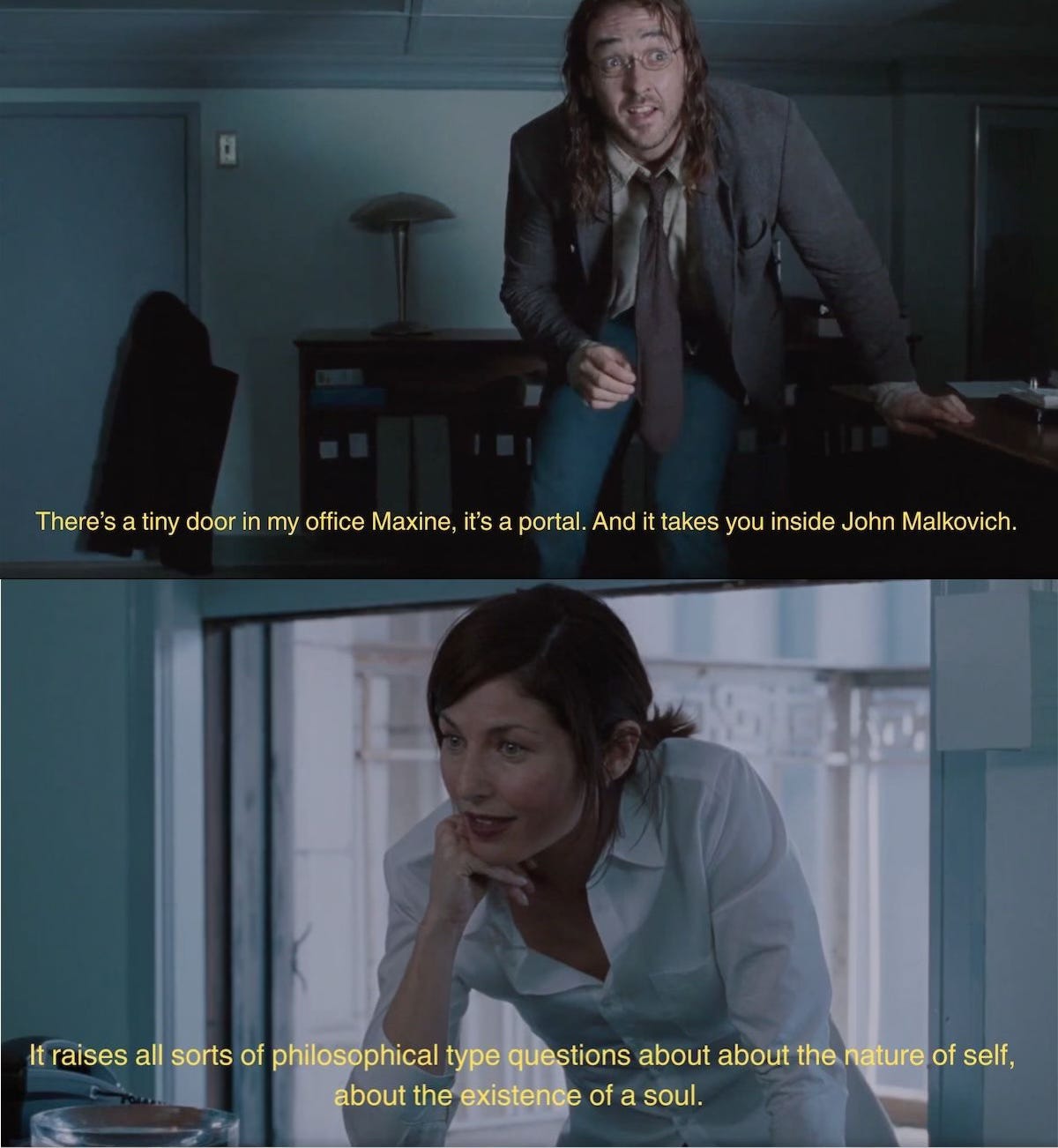
I think this is why chemistry feels so good. Why “being seen” has caught on as a collective longing. But since so many of us crave it, it begs the question – are we in a chemistry deficit?
Put another way, do we pay enough attention to each other?
Do we still flirt? Tease? Play with tension and release? These words don’t have a lot of gravity, but I think the abilities they suggest are essential to being human.
I started asking around. Mostly with my friends, but also with a few open-minded strangers. The two questions I asked were:
What does chemistry feel like for you?
Where do you think it comes from?
The answers to the first were all over the map (and I will share some of them because they were really cool). But the answers to the second had some common themes, and in 2025, these themes seem instructive.
Your ability to feel chemistry is proportionate to your ability to pay attention
When I asked people where they thought chemistry came from, admiration was a starting point. A reliable hook for attention.
“I really wanted you to like me,” one guy said to another when I threw out this question. He’s a student at the gym where I work, the other is his gymnastics coach.
“I wanted to kick it, and I hoped that eventually…you’d think I was cool enough for that.”
I was so touched by this? Not only because here we were, kicking it – proof he was cool enough for the coach – but because he was so honest about it. We were a group sitting on a towel-and-blanket island at Barton Springs, so it worked out for them. And by the way, none of this was romantic: just a dude admiring another dude, openly.
But circumstances are important here. The student was paying attention to his coach partially because he’d paid money for a class. Admiration had a built-in power differential, which can be fun, but it’s not chemistry. One-way admiration (crushes, thinkers I admire, various teachers I’ve had) fulfills a different need. Chemistry turns on mutuality: the energetic thread pulses because we’re both holding it.
Still. The ability to pay real, deep attention to anyone at all is crucial. And more noticeable as time goes on, because it’s a pro-social ability, and our current technology creates and exacerbates anti-social tendencies.
Now of course — you can use tech to connect. I blithely throw out a text in the group chat, and I’m halfway to weekend plans. So much easier to socialize as an adult now than it was for my parents, who had to make individual landline calls to potential cool hangs. (Can you imagine?)
But the more technology “innovates,” the more it drains life of natural, human friction. This replaces awkwardness and serendipity – the nectar of connection – with ease and convenience.

“Our social fabric is being designed by people who do not have social skills themselves,” said Sigin Ojulu in this post which you should absolutely watch (the irony I know but trust me).
“We’ve built systems optimized not for empathy and connection, but for control. People who want control over an environment they may not be able to dominate in real life.”
A) she speaks the truth, and B) friction is taking micro, interpersonal risks. Will you save my place in this grocery store line so I can run and grab dental floss? Watch their laptop at the coffee shop so they can go to the bathroom? None of this is control – it’s cooperation – and I’m starting to really think about the personalities who prefer the former to the latter.
If life is the easiest and most convenient it can possibly be, then it’s ultimately not very human. Life requires dealing with other people and ideally, tuning into them long enough to figure out how you can both navigate an unpredictable moment. Also: what is the endpoint? I think all the time about the ship of fools in WALL-E, people rotting in easy chairs while AI screens cackle “YOU’RE GORGEOUS!”
That’s the thing about frictionlessness. It’s a real value for the people advancing this technology. Frictionlessness is great for capitalism, but terrible for chemistry. And I (perhaps you, too) want chemistry. Like, all the time.
But OK. Let’s say you’re already skeptical of too much tech. Let’s say you already bend humanist, you enjoy paying attention to people. What makes another person look back at you? When do things go from admiration, to recognition?
From “I really wanted you to like me” to “we like each other?”
You feel more chemistry when you have interiority
I’m trying this new thing when I’m on an elevator, or standing in a line: I don’t look at my phone. This makes me feel at the very least less basic. But it also strengthens my highly atrophied muscle of noticing, of feeling more somatically connected to the flow of the world around me, as Yumi Sakugawa puts it.
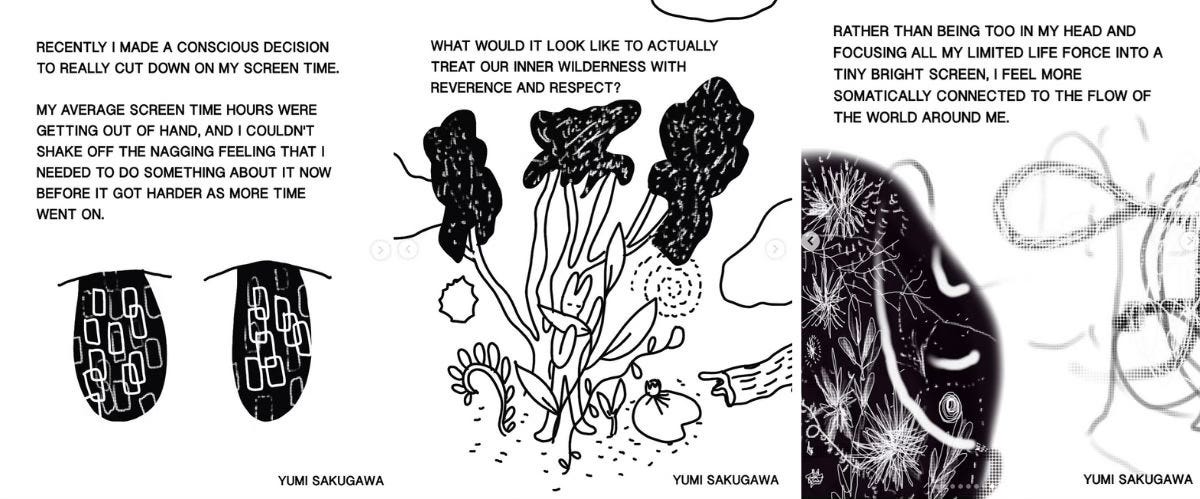
Sometimes I look around to see if anyone else is also doing this experiment. My people: the willingly bored. So far not many, but, maybe it’ll catch on.
When I reflexively pull out my phone, my mindset is more consumeristic, more controlling. I have an end that I want to achieve (hearting clothes on Poshmark so the sellers will offer me 20%-off discounts) and I do it. Zing, dopamine. But getting out of the goal/achievement frame of mind and into the open/discovery frame of mind is the second step towards experiencing more interpersonal chemistry in your life, I think.
Not because only because putting your phone away increases your odds of human interaction. But because this subtle yet powerful thing happens: you get more comfortable with your own company. And your interiority naturally enriches itself.
“I think chemistry depends on how YOU show up,” said D when I asked my questions. “It’s a reflection of where you are in life and the kind of people you vibe with.”
I pondered this for a while.
This idea that the better I know myself – the more comfortable I am in my own skin – the more legible I am to others.
I say this as someone who used to be so pleasantly vague. Generally appealing to almost everyone. I remember being 22, having a conversation with my co-workers (also in their 20s) about what desserts we would be (again, 20s). S looked at me, cocked her head, and said,
“You…are banana bread.”
“Banana bread?” I asked. “Because it’s comforting?”
“No,” she said. “Because everyone likes it. Even people who don’t like bananas like banana bread. It’s warm, it’s sweet, it’s good.”
In other words: generic. Nothing bitter or sour. Nothing challenging or strange.
I realized this was a great way to make tons of acquaintances and few if any real friends. I realized I had a pattern in life of becoming socially popular wherever I was, but carrying almost zero connections into the next phase of my life. The only ones that lasted were the ones who carried me, the people who at least knew themselves well enough to trust there was potential here.
As I started following my instincts more, my people-tastes started sharpening. (“The kind of people you vibe with.”) And my interpersonal connections lasted longer.
The cute girl I met on 6th St. in sartorial suspenders and shorts, alone in a sea of chunky Kendra Scott necklaces and high heels? Still one of my best friends to this day. I’m a reader at her upcoming wedding. The decision to take my first aerial silks class, despite being neither graceful, nor strong, nor flexible? My first few months of class were hilarious and unnerving, but that choice led me to other movers. Who turns out are very much my people.
Every little yes, even if it didn’t make immediate sense, was – unbeknownst to me – creating a map. Both to other people, and for other people back to me. Yes, yes, yes: here I am! No, no, no: wrong way. That’s what following your instincts does. It constructs an inside you that eventually matches the outside you. And natural, intuitive chemistry with others tends to follow this synchronization, because now others can read you better.
Unmistakable signs of chemistry
People-attention and self-knowledge: these are two essentials for feeling more chemistry in your life. But what does chemistry feel like for you?
Here’s what some people shared with me:
“I was in fifth grade, walking next to my friend on a field trip. We were carrying our backpacks, and had just gotten off a bus. I can’t remember what we were talking about, but all of a sudden I felt this warm sensation in my stomach. A welling-up. It started to rise through my chest, my neck, my face, and then out through my arms and fingers. Like electricity. I almost cried. In that moment I knew this girl was going to end up being a really important person in my life…and she was.”

A stranger told me this at Kinda Tropical, a bar in east Austin. She told me that ever since that day, she’s experienced this same feeling again with other important-life-people. Both romantic and non. Her body’s preview of personal significance, early threads of attachment being stitched in real time.
I also loved this one:
“To me chemistry feels like ‘oh, it’s you.’ Like we know each other already. Past lives? Maybe we met somewhere before, in different forms? To me it feels less like we’re introducing ourselves for the first time, and more like we’re meeting back up.”
–My friend B, over generously nutritionally-yeasted tacos at Bouldin Creek Cafe. She also said how relaxing it feels to meet someone like this, how much less explaining is involved. You vibe because you get it, even if you don’t know what “it” is. Doesn’t matter.
Sometimes, the people I asked turned the question back on me:
Maybe it’s a funny place to start, but the first thing I thought of is what it feels like to not have chemistry with someone. Especially with people who, for whatever reason, you have to regularly interact with. Like dancing with someone over and over again who’s just standing there, waiting for the song to end. It’s like hey, I get it, but we’re both at this wedding and “Uptown Funk” just came on and could ya at least move your arms a little? I look dumb too but c’mon, let’s be dumb together! (You say, as they look over your shoulder at canapés.)
That abject lack of presence completely sucks. But you know what feels amazing?
When you’re talking to someone and (to continue the song metaphor) it’s like improv jazz – that giddy feeling in my chest of being inside a moment both temporary and alive. Unpredictable but harmonious.
People who make me feel safe also conversely make me feel excited, like wherever this conversation (/sex) goes is OK, because what matters is we’re both genuinely collaborating. We’re building something that didn’t exist a moment ago.
Which reminds me of something I read the other day.
An article about EEG scans of people deeply engaged in conversation. As they got into it, their brain waves started syncing up, vibrating in similar patterns. Or, what musicians call resonance.
I shared this with R, who incidentally is a musician. Told him that’s what chemistry feels like for me. A syncing up, a noticeable drop in effort, because we’re both being carried along by the way we naturally are around one another. The waves are carrying us, we’re just showing up. We’re compelled enough to be present, the mysteries of the other more fascinating than the contents of our own minds.
He looked into my eyes a second longer than he normally does. Smiled.
The check came, but he didn’t flinch.
Oh, i love everything about this!! Serendipity and Awkwardness issa missing thing these days. People watching is one of my fav hobbies. I people watch a lot and come up my own stories of people in my head which i enjoy a lot! Maybe that’s my fav way of being “willingly bored.”
SPECTACULAR piece tolly!!!